
When Software Becomes As Disposable As Your MySpace Profile
Here’s the thing: disposable software isn’t coming. It’s already here. And just like when Napster first showed up and the record labels insisted nothing would change, most people are completely missing what this transformation actually means for how we build and buy technology.
Let’s be honest about what’s happening. The entire venture capital model was built on a simple premise: software is expensive because engineers are expensive. You needed capital to hire elite teams to build anything meaningful. That assumption just evaporated faster than a Geocities page.
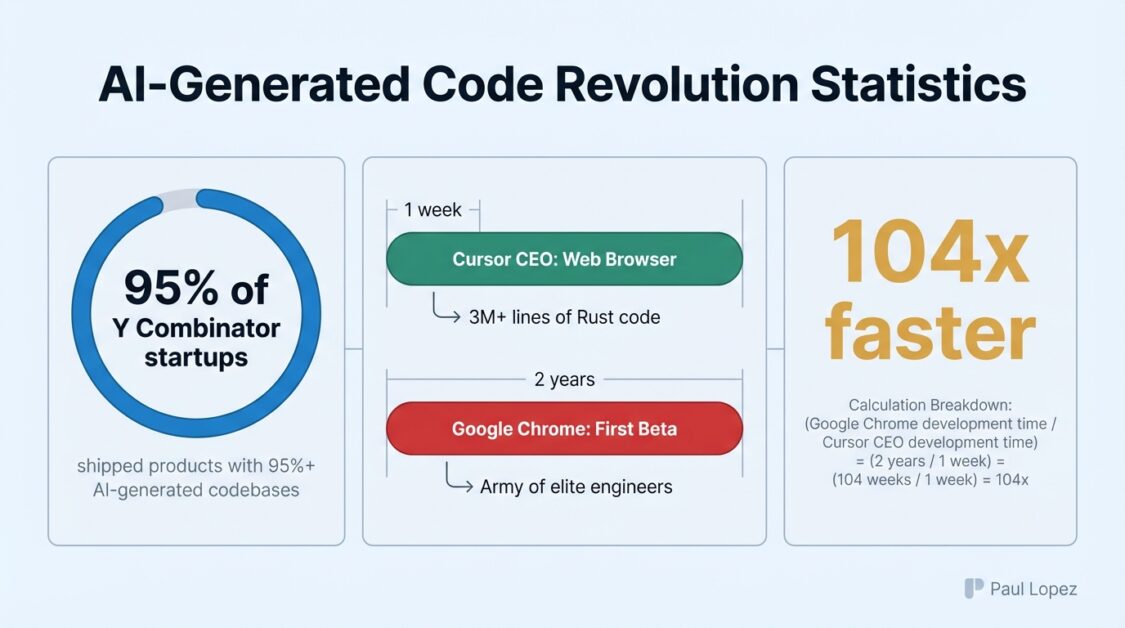
According to the latest Y Combinator batch, 95% of startups shipped products with codebases that were over 95% AI-generated. The CEO of Cursor recently built a web browser from scratch in one week, generating over 3 million lines of Rust code. Google Chrome took two years and an army of elite engineers just to ship their first beta. Think about that ratio for a minute.
The Real Impact: We’re Not at Hogwarts Anymore
When you can describe what you want in plain English and receive working code, three things disappear simultaneously: the engineering bottleneck, the capital requirement, and the team requirement. The cost of software isn’t trending toward zero. It already collapsed.
Much like digital photos replaced film, software is becoming disposable because producing another one costs approximately nothing. But here’s what most people miss: this doesn’t mean the process is free. While the cost of generating code has collapsed, the cost of directing attention toward a goal has not.
Anyone can generate a demo. Turning it into production software still requires someone to debug, maintain, and evolve it. This distinction separates the signal from the noise.
Two Games, One Name
We’re actually watching two completely different phenomena that keep getting lumped together. First is throwaway software for personal use. This represents genuine democratization, where people build one-time dashboards or small apps for personal needs. Notably, 75% of Replit’s customers never write a single line of code. They simply describe what they want.
Second is disposable features within enterprise products. This is more dangerous. It involves shipping a constant stream of features to see what “sticks” empirically with customers, treating your product roadmap like a game of Battleship where you just keep firing until something hits.
Companies like Cursor follow a philosophy they call “code is reality.” If you aren’t touching code, if you’re in meetings or planning or designing, you aren’t doing meaningful work. In this model, traditional rituals like stakeholder alignment, user research, and roadmap planning become overhead rather than insurance.
To be fair, this works brilliantly for their target audience. Developers have a high tolerance for instability and regressions. They can fix things when they break. But here’s where the model falls apart for the rest of the business world.
The Enterprise Reality Check
Enterprise customers aren’t buying software. They’re buying reliability and peace of mind. They buy products like Salesforce precisely so they can ignore them and focus on their core competency. They want a product that works the same way on Tuesday as it did on Monday.
The gap between developers and CIOs is a chasm. Developers can fix things when they break. CIOs get fired if the payroll doesn’t run. It’s the difference between viewing software as a creative medium versus viewing it as critical infrastructure.
The popular argument that companies will soon “vibe code” their own versions of Salesforce has a fatal flaw: attention is the real constraint. A company chasing a billion-dollar opportunity cannot justify diverting its highly skilled builders to maintain an internal CRM. According to basic opportunity cost principles, that makes zero business sense.
Furthermore, maintenance burdens don’t disappear just because AI wrote the code. AI-generated code still accumulates technical debt. Recent research shows it introduces security vulnerabilities in nearly half of all coding tasks. Someone still has to own that mess.
What Healthcare Actually Needs
In healthcare, these stakes multiply exponentially. You’re not just risking a buggy feature. You’re risking patient safety, HIPAA compliance, and regulatory scrutiny that can shut down an entire organization.
Healthcare providers are already drowning in attention debt. Physicians spend more time clicking through electronic health records than examining patients. The notion that they’ll suddenly become “citizen developers” maintaining their own clinical workflows is fantasy. They need software that works reliably while they focus on keeping people alive.
Healthcare IT leaders need proactive reliability. That means reliability first: you must prove the product works, is secure, and has human support before introducing autonomous features. Then comes proactive capability. Instead of a reactive chatbot waiting for a prompt, the software should proactively analyze data and take action, like identifying potential drug interactions or flagging high-risk patients.
Consider this: a simple terminal-style interface like Claude Code succeeds because it’s a buffer. The underlying capabilities can change constantly without requiring a GUI redesign or rearranged key bindings. For healthcare applications drowning in complexity, simpler interfaces help users understand and trust the actions taken by proactive agents.
The Four Fatal Assumptions
The current conversation around disposable software is flawed for four critical reasons. It treats all software as equivalent, assuming a vacation planning app and a hospital EHR are the same thing. It ignores opportunity cost, forgetting that attention is more expensive than code.
It underestimates the value of reliability over features. And it treats the edge case, developers, as the general case for all software users. These assumptions work great in a demo. They fail catastrophically in production healthcare environments.
Know Which Game You’re Playing
You must know which game you’re in. If you’re building for developers, maximum execution speed is your imperative. Ship fast, break things, iterate based on what sticks. Your customers can handle the instability because they’re builders themselves.
If you’re building for healthcare enterprise, you must earn the right to be proactive by first being impeccably reliable. You need to prove your software won’t break at 2 AM when the on-call physician is trying to access critical patient data. You need to demonstrate HIPAA compliance isn’t just a checkbox but a fundamental design principle.
The age of disposable software is here. But disposable doesn’t mean careless. It means knowing exactly what you’re building, who you’re building it for, and what failure actually costs in your domain. In healthcare, the cost of failure isn’t a bad user review. It’s measured in human lives.
That’s not being dramatic. That’s just being honest about what reliability actually means when the stakes are real.