
Going Slower Feels Safer, But Your Domain Expertise Won’t Save You Anymore. Here’s What Will.
Your 15 years of healthcare operations experience just became table stakes. That deep knowledge of financial modeling? Still valuable, but only if you can apply it through AI agents. Welcome to the Great Collapse, where traditional career planning just hit a wall at 200 miles per hour.
Something fundamental is happening to work that most professionals are missing. When I say AI is “collapsing futures,” I don’t mean destroying careers. I mean compressing multiple dimensions of professional life into a single, unavoidable trajectory: master AI orchestration, or watch your expertise become obsolete.
This collapse is happening across two critical dimensions simultaneously. Understanding both is essential for anyone who wants to remain competitive past 2026.
The Horizontal Collapse: When Job Titles Stop Mattering
Engineer. Product manager. Healthcare administrator. Financial analyst. Designer.
These used to be distinct career paths with clearly defined skill sets. That distinction is evaporating faster than a Spinal Tap drummer’s lifespan. By late 2026, all of these roles will converge into variations of a single meta-competency: orchestrating AI agents to get work done.
The numbers tell the story. Gartner predicts that nearly half of enterprise applications will integrate task-specific agents by the end of 2026, up from less than 5% in 2025¹. Meanwhile, 57% of companies already claim to have AI agents in production as of 2025². That’s not gradual adoption; that’s a tsunami.
Here’s what this means for healthcare specifically: your clinical expertise still matters, but only as the foundation for directing AI systems. A nurse practitioner’s decade of patient assessment experience becomes invaluable for training diagnostic agents. But without AI orchestration skills, that expertise hits a ceiling.
Consider how quickly roles are already transforming:
– Legal teams compress weeks of contract review into hours using AI
– Finance teams build complex projections in minutes that used to take days
– Customer success teams deploy agents handling 80-95% of initial inquiries
– Healthcare systems use AI to analyze patient data patterns across thousands of cases simultaneously
What used to be 50 different specializations is converging into variations on a single theme: humans with domain knowledge directing AI agents toward specific outcomes.
The critical skill here is what I call “software-shaped intent.” You need to think in terms of what agents can actually deliver within their technical ecosystem. Where are the agent’s tools? What’s its memory structure? How does its workflow operate? When you direct an agent to accomplish something, will the result be software-shaped, meaning it creates interfaces that can effectively read and write data to solve your problem?
This used to be exclusively a product or engineering mindset. Now it’s becoming universal for survival.
The Temporal Collapse: When Five-Year Plans Become Obsolete
The second collapse is temporal, and it’s even more disruptive to traditional career thinking.
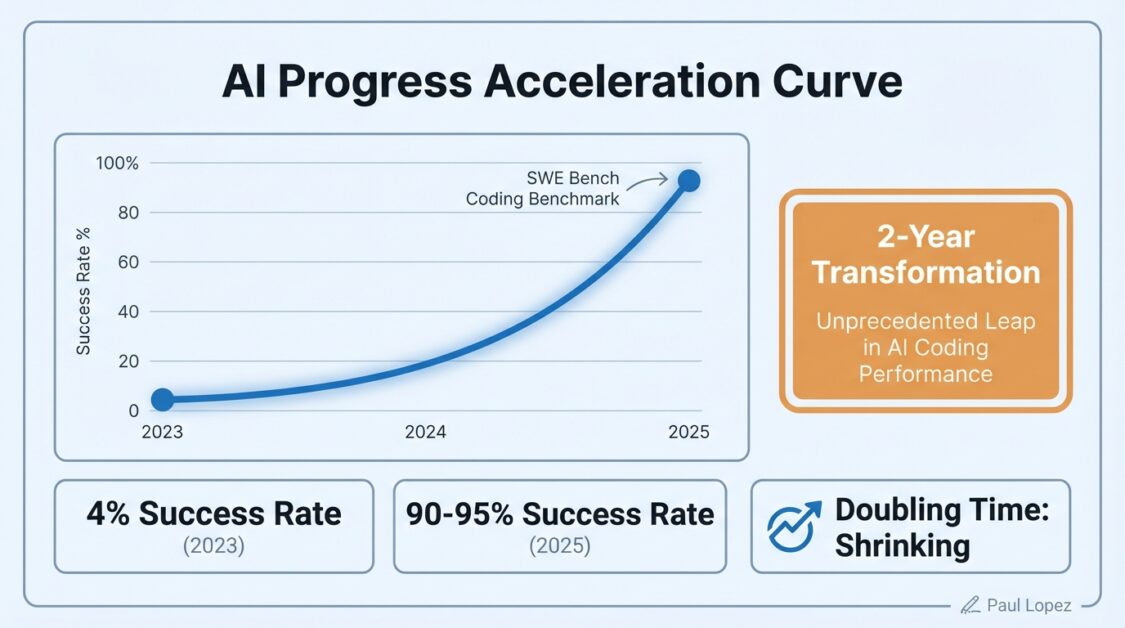
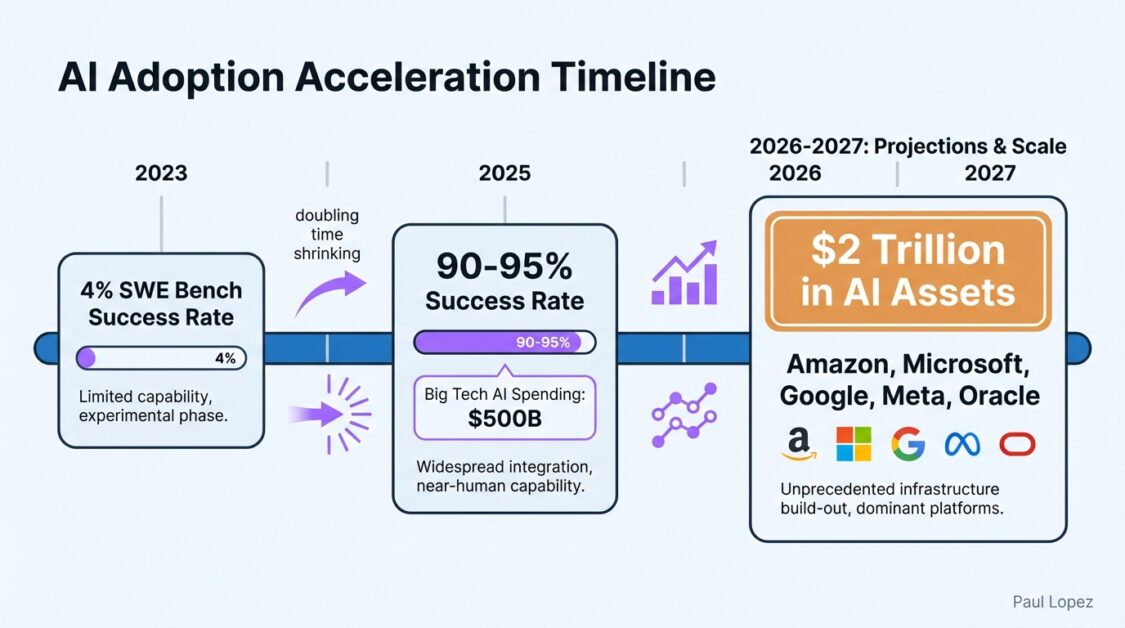
The leverage you thought you could build over the next five years is compressing into months. AI systems could solve 4% of problems on the SWE Bench coding benchmark in 2023. Two years later, they’ve essentially saturated the entire benchmark at 90-95% success rates³. The doubling time for these improvements is shrinking, which means AI progress is accelerating.
Traditional career planning assumed you had time: learn a skill, apply it for years, build expertise gradually, get promoted, eventually leverage that expertise in leadership roles. This timeline gave you breathing room to be strategic about when to invest your learning energy.
That assumption is now catastrophically wrong.
You have to plan for a career where AI capabilities are gaining speed at an ever-increasing rate. The skills that will matter in 2027 are being defined right now by people engaging with AI today. If you wait until the technology “settles down,” you’ll discover that early adopters have already built the workflows, established the norms, and captured the opportunities you were waiting for.
The old career model assumed your expertise appreciated over time. You’d learn something valuable, it would stay valuable, and gradually compound. The new model is fundamentally different. Your expertise depreciates unless you continuously update it, and that depreciation rate is accelerating.
Why Going Faster Is Actually Safer
Here’s where most people get it catastrophically wrong: they think slowing down with AI adoption is the cautious, safe approach.
It’s actually the opposite.
Think about learning to ride a bike. When you go slowly, it’s incredibly hard to balance. You feel unstable, like you’ll never get the hang of it. But when you go faster, the bike becomes steady. Kids struggle with this because they think going slower keeps them safer, but they’re actually safer going faster.
AI works the same way. Going slower forces you to constantly think about braking, stopping, adjusting, trying to work AI into your existing workflows bit by bit. But AI is developing too fast for that approach. You need to get on the bike and go as quickly as you can, because that’s actually the easiest way to balance.
The scale of what’s happening should eliminate any doubt about this urgency. Big tech’s combined AI spending approaches half a trillion dollars in 2025 and will exceed that in 2026⁴. Amazon, Microsoft, Google, Meta, and Oracle plan to add at least $2 trillion in AI-related assets over the next four years⁵. This represents the biggest capital expenditure project in human history.
The money is committed. AI is happening and will define the next era of computing so thoroughly that there is no alternative path.
The Path Forward
If you tried ChatGPT in 2022, decided it hallucinated too much, and walked away, that luxury is gone. You don’t have time to wait until AI “matures.” That’s like sitting next to a bike saying you’ll wait until it gets steadier. It’s not going to get steadier without you.
Here’s what I’ve seen work across healthcare, tech, finance, engineering, and product management:
Choose curiosity over resistance. Choose to engage with AI as a learning opportunity, even if you didn’t choose this moment of technological disruption. None of us did. The industry made this choice collectively, and we’re all living through it together.
When you choose that positive path and lean in, even when you’re not entirely sure what you’re doing, it accelerates your learning rate dramatically. You become less overwhelmed, not more. Curiosity literally opens up cognitive capacity, and we need that openness to shape AI in ways that work for us.
Start somewhere. Try Claude for analysis. Experiment with different approaches to chatbot interactions. Try new AI tools in your workflow. Then do the next thing. Lean in a little further.
You’ll start going faster and faster, and counterintuitively, it will feel steadier over time. You’ll begin picking up how AI works across different systems at an unconscious level. The patterns will solidify, and you’ll develop a stable way of working with this technology.
The future is arriving faster than our old planning models anticipated. But for those willing to engage with it directly, that future is full of leverage and opportunity that simply didn’t exist before.
You just have to get on the bike and start pedaling.
References
- Gartner prediction on enterprise AI agent adoption (2026)
- Current enterprise AI agent production statistics (2025)
- SWE Bench benchmark performance data (2023-2025)
- Big tech AI spending projections (2025-2026)
- Combined tech infrastructure investment plans (2026-2030)